Homepage Canonical Points to Inner Page? Forty-Six Million Visit Website Strategy
A few days ago, I saw someone share Consensus.app's SEO strategy.
I was stunned.
This website gets forty-six million annual visits (source: Consensus), but its homepage canonical tag points to the inner page /search/.
Counter-intuitive.
I spent an afternoon researching with Chrome DevTools before understanding the brilliance behind this.
Key Takeaways
- •Reverse canonical: Homepage points to inner page, preserving SEO weight and historical data
- •Three-zero-seven redirect: Temporary redirect doesn't transfer weight, search engines continue indexing original URL
- •Zero weight loss: Avoids three to six month weight transfer period from three-zero-one redirects
- •Use case: High-traffic products (over one million per month) with accumulated inner page weight
- •High barrier: Requires deep understanding of HTTP codes, canonical mechanics, crawler behavior
How Did This Problem Arise
Consensus.app is an AI academic paper search tool helping researchers find papers quickly.
But they made a common mistake:
The homepage was a beautiful landing page with only display functionality. Real search was on /search/ inner page.
Users all used the inner page. Homepage was just a facade.
The problem: Google gives more weight to homepages, but user behavior, backlinks, rankings all accumulated on /search/.
Like a restaurant with beautiful entrance, but customers eat in the kitchen.
Weight was scattered.
Real case: I built a tool site with same issue. Homepage had intro, tool at /tool/. Tool page ranked well, homepage ignored. Used three-zero-one redirect, traffic dropped thirty percent, took four months to recover.
Problems with Conventional Solutions
Four common solutions:
| Solution | Method | Pros | Cons | Risk |
|---|---|---|---|---|
| Do Nothing | Keep status quo | Simple, safe | Weight scattered | 🟢 None |
| Three-Zero-One Redirect | /search/ → / | Standard | Slow transfer, ranking drop | 🟡 Medium |
| Direct Migration | Move to homepage | Best practice | Too much change | 🟡 Medium |
| Consensus | Reverse canonical + three-zero-seven | Zero loss | Complex | 🔴 High |
Option 1: Do Nothing
Simplest, but wasteful. Homepage weight idle, inner page limited. Can't compete.
Option 2: Three-Zero-One Redirect
Most conventional. Redirect /search/ to homepage, let weight transfer.
Problem: Weight transfer takes three to six months (Google docs).
Rankings fluctuate, traffic may drop twenty to fifty percent. Historical data lost. Could permanently lose over thirty percent traffic.
Option 3: Direct Migration
Ideal—make search the homepage, delete /search/.
But for live products: bookmarks break, backlinks disappear, logic needs reconstruction.
High cost, considerable risk.
Warning: If designing new product, put core functionality on homepage directly. Don't follow Consensus's detour—their solution is a "last resort" remedy.
Consensus's Clever Solution
Counter-intuitive operation:
Homepage canonical points to inner page /search/.
Meanwhile, /search/ does three-zero-seven redirect to homepage.
Sounds convoluted, but brilliant.
What Makes It Clever?
I checked their config with Chrome DevTools:
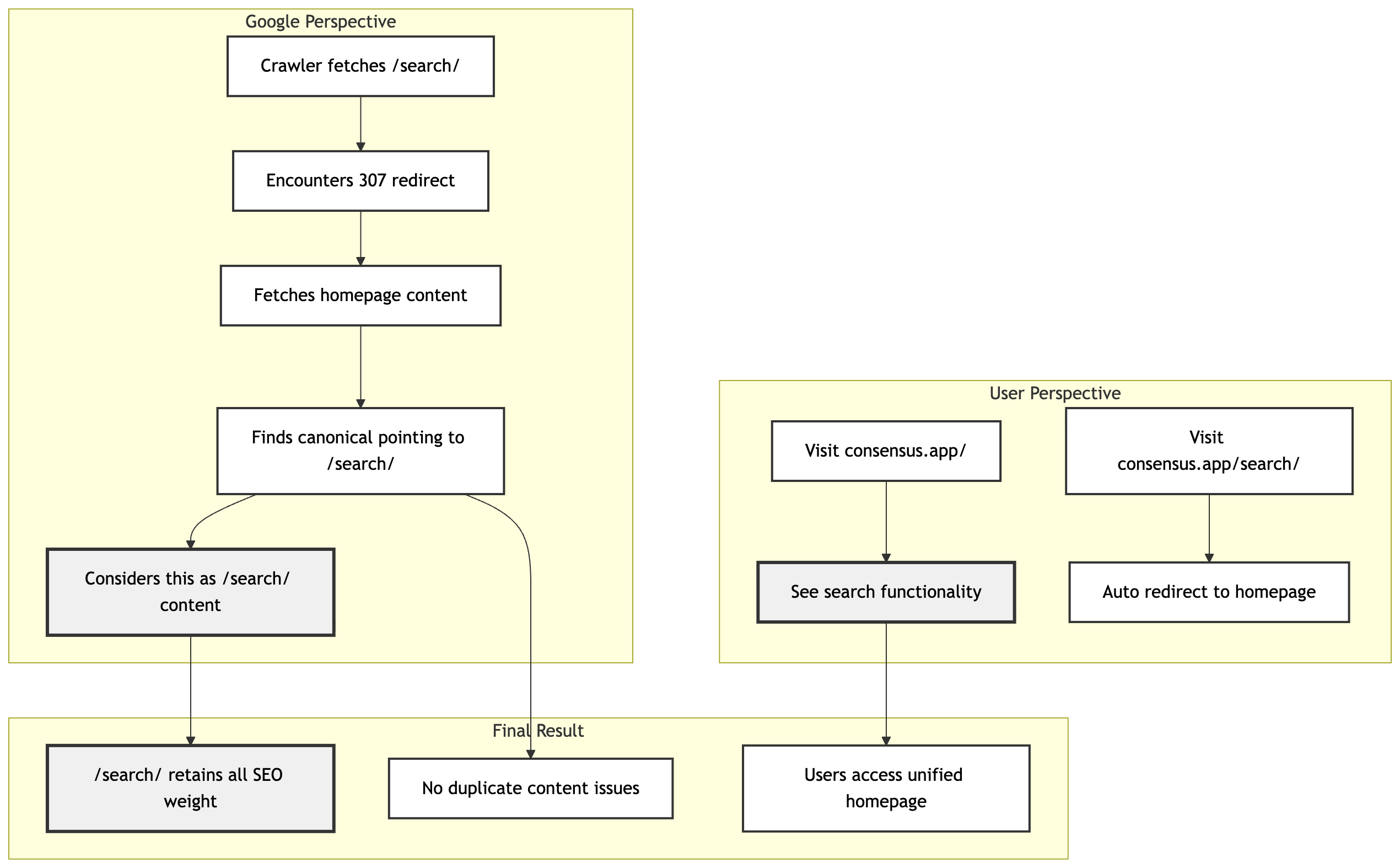
Users see: Homepage or /search/ both show search, unified experience.
Google sees: Crawls /search/, encounters 307, fetches homepage, finds canonical pointing to /search/.
Result: Weight, rankings, data stay on /search/ URL. Users access homepage.
Zero weight loss, zero ranking fluctuation.
Implementation
1. Homepage Config
<!DOCTYPE html>
<html>
<head>
<link rel="canonical" href="https://yoursite.com/search/" />
<title>Your Site - AI Search</title>
</head>
<body>
<div id="search-app"></div>
</body>
</html>
2. Inner Page Redirect
Nginx:
location = /search/ {
    return 307 /;
}
Apache:
RewriteEngine On
RewriteRule ^search/$ / [R=307,L]
Node.js:
app.get('/search/', (req, res) => {
    res.redirect(307, '/');
});
3. Verify
- •Open homepage, check Network tab
- •Confirm canonical in headers
- •Visit
/search/, confirm three-zero-seven redirect
Tool: Use KWVerdict for technical SEO checks. Note: currently supports basic canonical detection only; complex reverse configs need manual verification.
Why Three-Zero-Seven Not Three-Zero-Two?
| Feature | Three-Zero-One | Three-Zero-Two | Three-Zero-Seven |
|---|---|---|---|
| Type | Permanent | Temporary (old) | Temporary (new) |
| Weight | Transfers ninety-five to ninety-nine percent | No transfer | No transfer |
| Index | Updates to new | Keeps original | Keeps original |
| Method | May change POST→GET | May change POST→GET | Preserves strictly |
Three-zero-seven is HTTP/1.1 standard, more rigorous than three-zero-two (HTTP/1.0).
Is This for Everyone?
No.
Complex "last resort" operation. Requires understanding:
- •HTTP status codes
- •Canonical mechanics
- •Crawler behavior
- •Data binding
High maintenance cost. Only for experts.
Recommendation:
New products: Put functionality on homepage directly.
Live products: Choose by traffic:
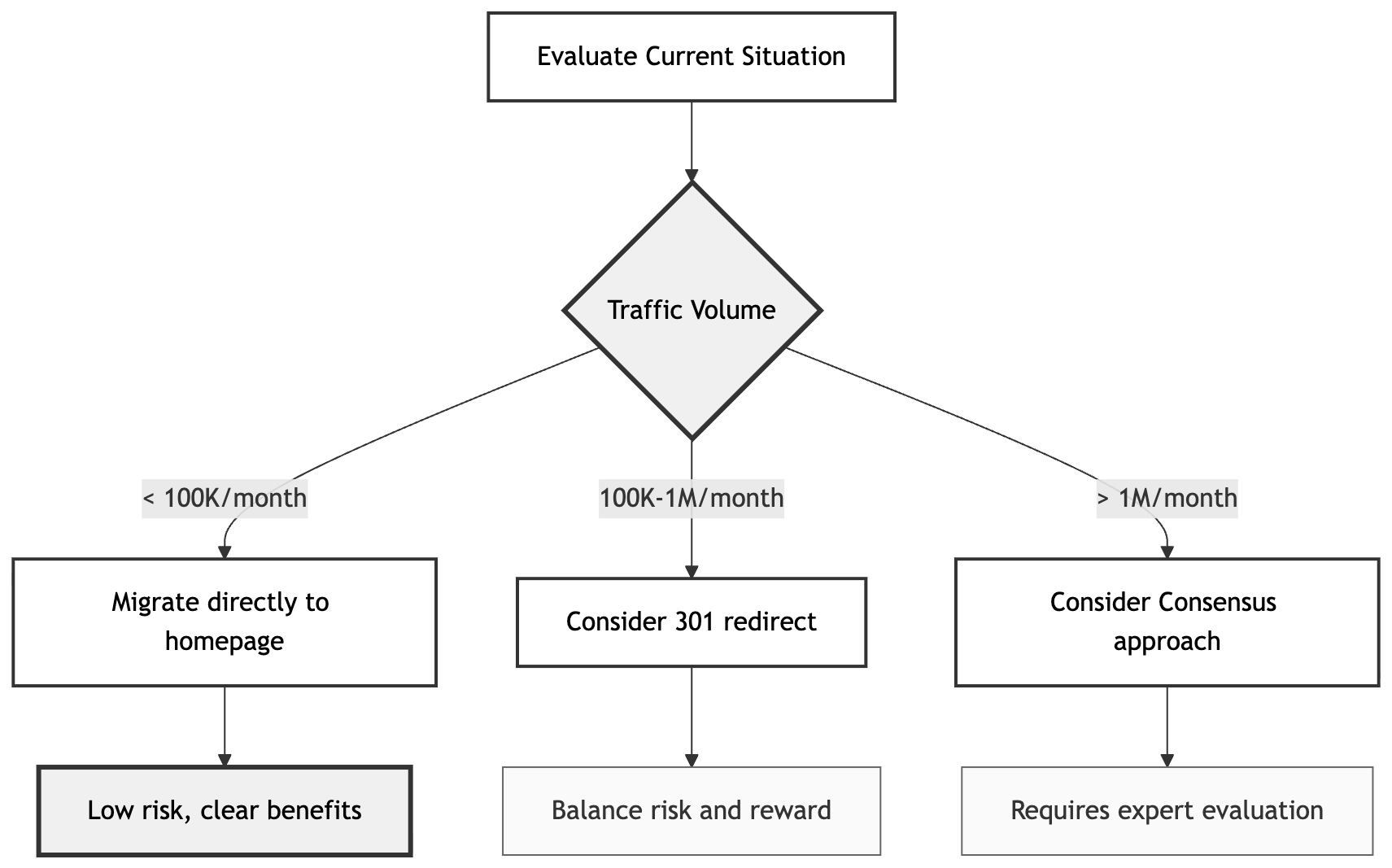
Small traffic: Migrate directly. Medium: Use three-zero-one, accept fluctuation. Large: Consider Consensus approach.
Final Thoughts
Key insight: Consider SEO in product architecture from start.
Unify functional and SEO pages, avoid later hassles.
But if mistake made, remedies exist. Just different costs.
Choose right solution for yourself, not blind imitation.
Frequently Asked Questions
›Will reverse canonical be considered cheating?
No. Canonical tells search engines canonical version location. Same content, any URL is legitimate. Google doesn't prohibit this.
›Can I use this with low traffic?
Not recommended. High complexity, only worth it for over 1M monthly visits with accumulated inner page weight. Small sites should migrate directly.
›Will 301 really cause traffic drop?
Yes. Per Google docs and cases, 301 transfer takes three to six months. Rankings fluctuate, traffic may drop twenty to fifty percent. My project took four months to recover.
›Difference between three-zero-seven and three-zero-two?
Request method preservation. Three-zero-two (HTTP/1.0) might change POST to GET. Three-zero-seven (HTTP/1.1) strictly preserves method. Three-zero-seven more rigorous.
›What if I have homepage display + inner page functionality now?
Evaluate traffic. Under 100K: migrate directly. 100K to 1M: consider three-zero-one. Over 1M: get expert evaluation for Consensus approach.
Resources:
- •Consensus - Forty-six million visit case study
- •Google Three-Zero-One Docs
- •HTTP Redirect Guide
- •Canonical Best Practices
Source: Shared May 4, 2026 | Verified: Chrome DevTools