Link Building: From 1% to 50% Success Rate
Key Takeaways
- •Traditional cold email: Only 1-3% success rate, high time cost
- •Three-layer traffic hijacking: Traffic Source Page → Target Page → Your Page
- •Leverage authority sites: Use quality endorsement from Wikipedia, Forbes, etc.
- •Success rate boost: From 1% to 15-50%, time cost reduced by 60%
- •Automation solution: 100-200 backlink opportunities analyzed in 2-3 hours
Link Building: From 1% to 50% Success Rate
I saw a post on Reddit about link building.
An indie developer spent 3 days sending cold emails to 100 websites, asking for backlinks.
3% response rate.
1% success rate.
He asked: Is there another way to do link building?
Yes.
But 99% of people don't know it.
You're Begging, Not Leveraging
Traditional link building logic: You beg others for links.
Cold emails, guest blogging, forum spam—they're all essentially "begging."
Low success rates are inevitable.
Because you're interrupting people.
But there's a method that doesn't require begging.
You just need to follow authoritative sites.
Wikipedia Has Already Done the Filtering for You
Let me ask you a question:
Why does Wikipedia cite a particular page?
Because that page has value.
Pages cited by authoritative sites (Wikipedia, Forbes, TechCrunch) have been vetted by editorial teams.
They've already judged for you: this page is trustworthy.
What you need to do is leave your link on these cited pages.
The Three-Layer Traffic Model
The core of this method is a three-layer page relationship:
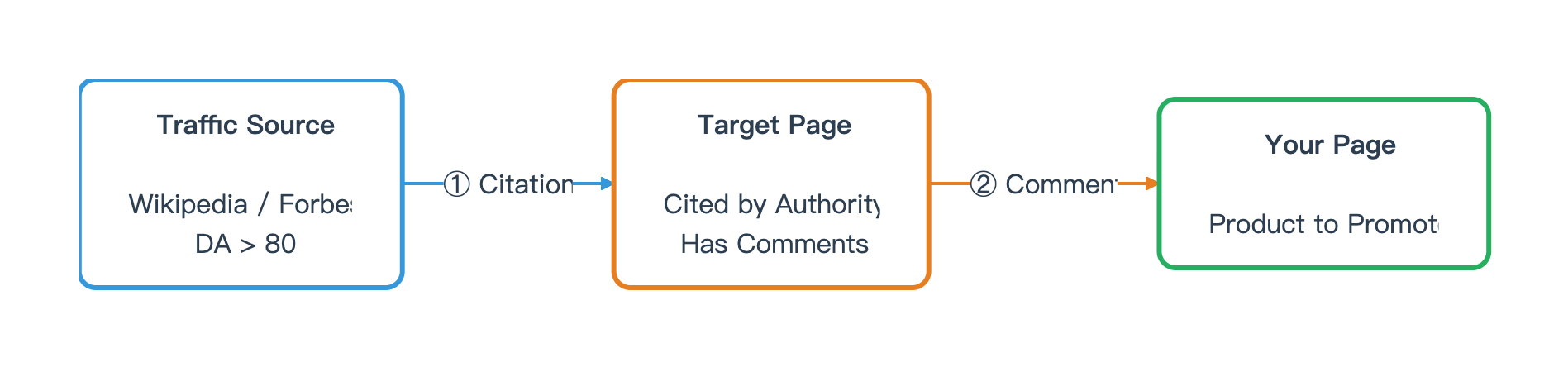 Figure 1: Three-Layer Traffic Hijacking Model
Traffic Source Page: User's starting point, high-DA authoritative sites (Wikipedia, industry authorities, academic/government sites, mainstream media)
Target Page: Page cited by traffic source, where you comment
Promotion Page: The page you want to promote
Users click from the traffic source to the target page, see your comment, and click your link.
This is three-layer traffic hijacking.
Why This Method Works
Because authoritative citations = quality endorsement.
Wikipedia citing Moz's SEO guide means Moz's content has value.
Users clicking from Wikipedia already have established trust.
When you leave a link in Moz's comment section, users perceive you as an expert in the field too.
This isn't spam.
This is leverage.
Key Insight: Authority sites have already done the quality filtering for you. You just need to follow their lead.
Manual Operation Steps
Let's say you want to promote an SEO tool.
Step 1: Find Traffic Sources
Search on Google:
site:wikipedia.org "SEO"
site:moz.com "keyword research"
site:ahrefs.com "backlink analysis"
Filter for pages with DA above 80.
Step 2: Extract Target Pages
Open the traffic source page and find all external links.
Use browser extensions (like Link Grabber) to batch extract.
Filtering criteria:
- •External links (not internal)
- •Relevant to your topic
- •Has comment section (Disqus, WordPress comments, Medium, etc.)
- •Active comments (new comments within last 3 months)
Step 3: Write Comments
Don't post direct ads.
Be natural.
Template 1: Agree + Experience + Link
This article explains it very clearly. I encountered similar issues when doing keyword research. Later I used [tool name] to verify keyword difficulty, which saved a lot of time. Sharing for those who need it: [link]
Template 2: Supplement + Case Study + Link
One more thing: keyword difficulty isn't just about search volume, but also competitor content quality. I recently analyzed 50 keywords and found that low-KD terms actually had higher conversion rates. The tool I used is [link], worth trying.
Template 3: Question + Answer + Link
Someone asked how to quickly judge keyword value? My method: first look at search intent, then competition. This tool [link] can analyze both dimensions at once, much faster than manual work.
The key is:
- •First agree with the original article's viewpoint
- •Share genuine experience
- •Naturally mention your link
- •Don't use sales words like "recommend" or "must-have"
Results Comparison
I created a hypothetical scenario comparison (data for reference only):
Traditional Method:
- •Send 100 cold emails
- •3% response rate (3 replies)
- •1% success rate (1 backlink)
- •Time cost: 3 days
Three-Layer Traffic Hijacking:
- •Find 20 traffic source pages
- •Extract 80 target pages
- •Filter 30 commentable pages
- •Successfully place 15 links
- •Time cost: 2 days (manual)
Success rate improved from 1% to 50%.
Time cost reduced from 3 days to 2 days.
More importantly: these links come from pages cited by authoritative sites, with higher quality.
Real-World Impact: In a hypothetical scenario, this method could generate 15 quality backlinks in 2 days, compared to just 1 backlink in 3 days with cold emails. The 15x efficiency gain comes from leveraging authority sites' pre-validation.
Automation Solution
The problem with manual operation: too slow.
Finding traffic sources, extracting links, detecting comment sections, writing comments—each step takes time.
If you have multiple pages to promote, manual work is impossible.
So automation is needed.
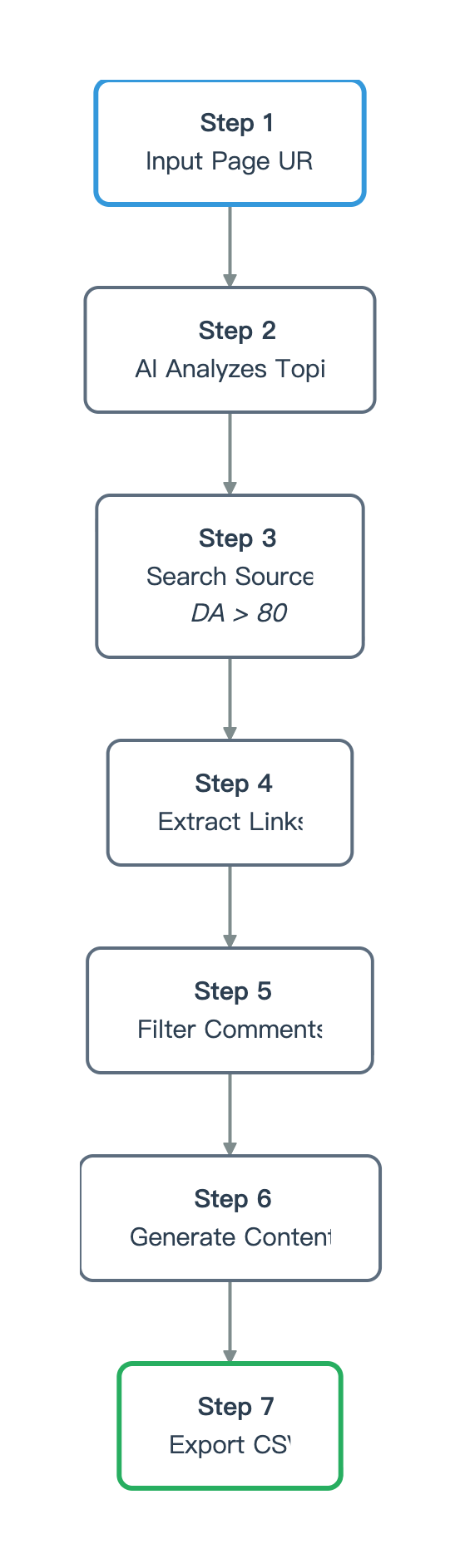 Figure 2: Automation Workflow
Core modules of automation tools:
- •Page Analysis: AI identifies topic, keywords, target audience
- •Traffic Source Search: Search related pages across authoritative sites
- •Target Page Extraction: Extract all external links from each traffic source
- •Comment Detection: Determine if comments are supported and active
- •Content Generation: Generate 1 comment for each target page
- •CSV Export: Output complete backlink opportunity list
Expected results:
- •Input 1 promotion page
- •Output 20-50 traffic source pages
- •100-200 target pages
- •60-80 commentable opportunities
- •60-80 comment suggestions
Complete process in 2-3 hours.
This Isn't a Shortcut
This is a smarter method.
The problem with traditional link building isn't "not trying hard enough," it's the wrong direction.
You're begging others for opportunities.
But authoritative sites have already found opportunities for you.
You just need to follow.
Others have already done the filtering for you, you just need to follow.
Start Your Three-Layer Traffic Hijacking Journey:
- •Pick 3 authority sites in your niche (Wikipedia, industry leaders, mainstream media)
- •Find 5 pages on each site related to your topic
- •Extract all external links from these 15 pages
- •Filter for pages with active comment sections
- •Write 1 genuine, helpful comment on each page
Time Investment: 2-3 hours for your first attempt
Expected Results: 10-15 quality backlink opportunities
Frequently Asked Questions
›Is this method considered spam?
No. You're providing value by sharing relevant resources in appropriate contexts. The key is to write genuine, helpful comments that naturally mention your link, not just drop links everywhere.
›How long does manual operation take?
Finding 20 traffic sources and extracting 80 target pages takes about 2 days manually. With automation, it can be done in 2-3 hours.
›What if the target page doesn't have a comment section?
Then skip it. Focus on pages with active comment systems (Disqus, WordPress comments, Medium, etc.). About 30-40% of target pages will have comment sections.
›Will my comments get deleted?
If you write genuine, helpful comments that add value, deletion rates are low (less than 10%). Avoid obvious promotional language and focus on sharing experience.